




At the end of PESTA BONEKA, the puppets take a rest—and the puppeteers start cooking
For many years, When Puppeteers Cook has become one of PESTA BONEKA’s most beloved traditions. Held on the final day of the festival, it begins with a simple invitation: every participating artist is asked to cook and share a favourite dish—something they love to eat, something that reminds them of home, a family recipe, or simply something they would like others to taste.
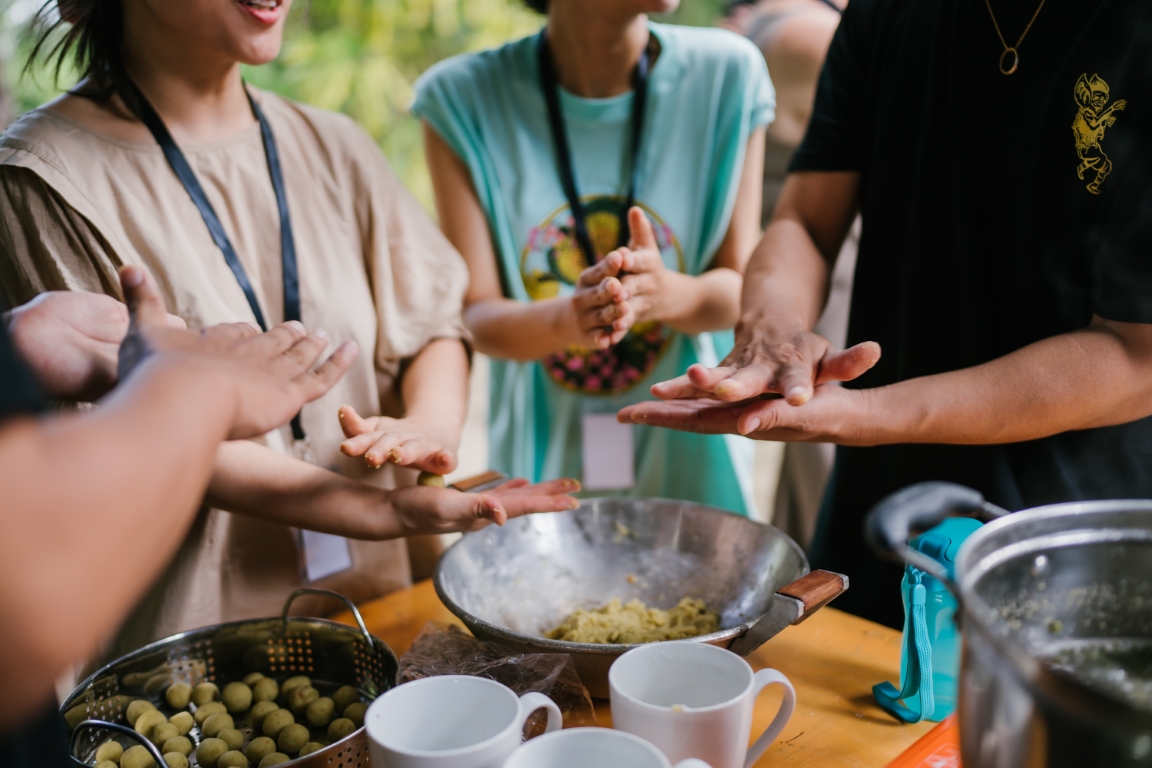
For a few hours, the festival transforms into a big shared kitchen. Artists who have spent the previous days performing, building puppets, exchanging ideas, and meeting audiences now stand around chopping boards, pots, pans, spices, and ingredients from different parts of the world. The smell of many kitchens begins to fill the space. Recipes are exchanged, unfamiliar ingredients become conversations, people help one another prepare their dishes, and eventually everything arrives on one long table to be shared freely with festival visitors, friends, neighbours, and the local community.
There is no stage and there is no distance between artist and audience. You might find yourself eating beside a puppeteer whose performance you watched the night before, asking about an ingredient you have never tasted, learning how a dish is prepared in another country, or simply sitting together without needing to speak the same language.
Over the years, we have discovered that food—much like puppetry—has an extraordinary ability to travel across languages and borders. A dish carries memories, places, families, histories, and ways of living. Through cooking and eating together, cultural exchange happens in its simplest and perhaps most intimate form: one person makes something with their hands, and offers it to another.
This is why When Puppeteers Cook has remained an important part of PESTA BONEKA. It is not simply a meal at the end of the festival, but a moment when all the relationships built throughout the week come together around the same table. Artists become cooks, audiences become friends, strangers sit next to one another, and the festival slowly closes not with a curtain call, but with conversations, laughter, recipes, empty plates, and the feeling that for a little while, we have shared something more than performances.
Perhaps this is also one of the simplest ways to understand the spirit of PESTA BONEKA: we meet, we make, we share, and before we say goodbye, we eat together.